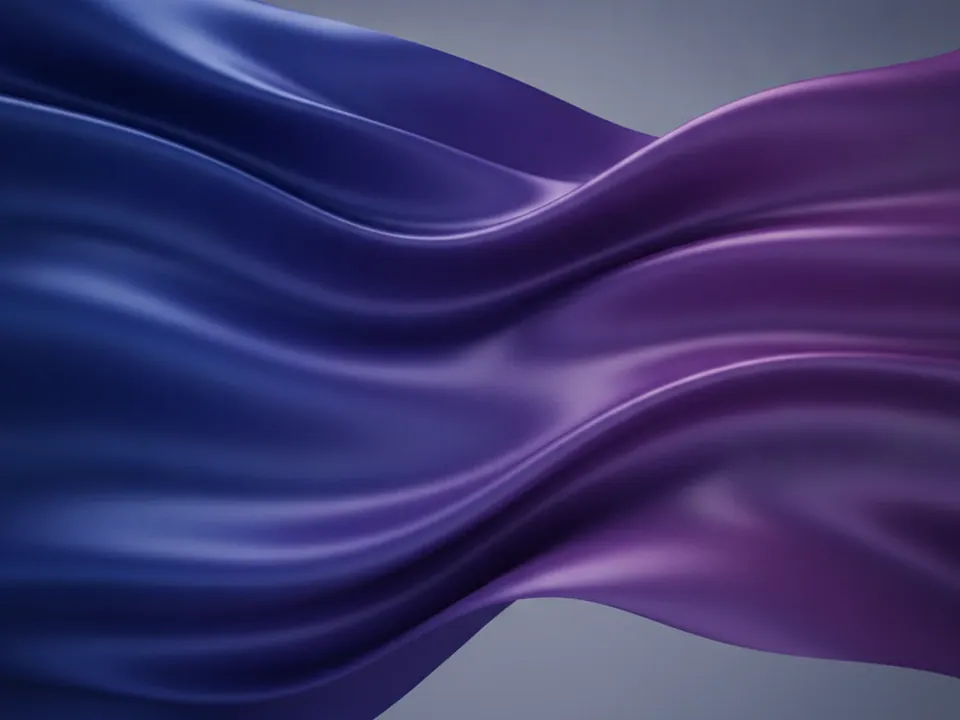
What is in the set
The set has four JPG files at 1600x1200 px, each a render of smooth, flowing satin waves in deep blue and violet. Soft studio lighting picks out glossy folds across the surface, and the composition stays abstract, with no logo, text or recognizable object.
The variants are named Original, Rose, Violet and Ember. Each shifts the overall hue: Rose warms the folds toward pink, Violet pushes further into purple, and Ember adds a warm amber undertone to the highlights. The wave shapes and lighting direction stay the same across all four, so you can swap a variant without reworking your layout.
Because the folds flow diagonally and fill the frame, the set crops well into wide hero banners, square cards or tall mobile sections without losing the sense of motion.

Where it works
This set reads as premium, modern and calm. It fits:
- SaaS, fintech and enterprise software landing pages
- Tech conference, summit and webinar pages
- Product launch and pricing pages that need a quiet backdrop
- Presentation and pitch deck cover slides
It belongs to 3D backgrounds. For a different material in the same style, see the 3D glass shapes background.
How to use it in CSS
At large viewport widths a single JPG can look soft when scaled far beyond its native size. Use image-set() to offer a plain fallback while hinting at a larger source for high density screens, and keep a dark blue fallback color close to the dominant tone.
.hero {
  background-color: #1a2440;
  background-image: image-set(
    url("waves-3d-violet.jpg") 1x,
    url("waves-3d-violet@2x.jpg") 2x
  );
  background-size: cover;
  background-position: center;
}
Browsers without image-set() support simply ignore the rule, so pair it with a standard background-image fallback above it in the same rule block. For guidance on when a CSS gradient alone would be enough instead, see CSS gradients vs image backgrounds.